


Cheapest Ways to Fly Business Class in 2026 (That Actually Work)
Let me be direct with you from the start: there is no magic trick that makes business class “free”. Anyone promising you that is either selling something, or hasn’t counted all the costs.
What does exist and what this guide is entirely about, is a set of legitimate strategies that can dramatically reduce what you pay for a premium cabin seat. Not tricks. Not manufactured loopholes that stop working the moment you try them. Actual approaches that I’ve used personally, across more than 2.4 million miles flown, that still work in 2026.
Some of these are cash strategies, finding genuine sale fares, knowing when airlines discount heavily, understanding how bidding systems work. Others sit at the intersection of cash and points. All of them require some combination of flexibility, timing, and knowing where to look.
If you want to understand the points side of this in depth, how to use Avios, Virgin Points and Amex MR to book business class — I’ve covered that separately in my full points strategy guide. This guide focuses on the cash and deals side, with some crossover where it matters.
Strategy 1: Know When Airlines Actually Run Genuine Sales
The first thing to understand is that not all “sales” are equal. Airlines have become increasingly sophisticated at presenting discounts that aren’t really discounts, reprice the base fare upward, add a 10-20% reduction, call it a sale. I’ve written about this problem before and it’s only got worse.

Many airlines are guilty of this, from Aegean, British Airways and Virgin.
The sales that are actually worth acting on tend to follow predictable patterns:
When genuine business class sales sometimes happen:
- January — post-Christmas clearance, airlines trying to fill Q1 inventory. Historically one of the best windows of the year
- Easter period: airlines launch spring sales targeting leisure travellers in February/March
- Black Friday / Cyber Monday: hit and miss, but some carriers run their best annual promotions here. BA, Virgin and Emirates have all had strong Black Friday offers in recent years
- End of financial quarter: airlines under revenue pressure often drop prices in late March, late June, late September
- Airline anniversaries and milestone events: carriers occasionally run promotional fares to mark route launches or fleet deliveries
I need to state that post-covid, genuine deals are ever so rare now and few and far between in any given year.
Airlines with a track record of genuine UK business class sales:
- British Airways — I covered the Spring 2023 BA sale when they ran some of the best transatlantic fares in years, with Club World to the US genuinely cheaper at that point than an equivalent Avios redemption would have been. BA tends to lead with US routes in these sales. Since then there has been no notable sales, that most frequent flyers would consider “deals”.
- Air France — covered their 2023 business class sale which included fares from £1,263 from multiple UK regional airports, not just Heathrow. Air France is worth watching because their sale pricing often extends to routes other airlines don’t discount.
- Finnair — a consistent and underappreciated sale airline. Covered their London to Phuket business class fare from £1,523 — available on A350 all the way, which is a genuinely good product. Finnair sales often aren’t even advertised on their main site; they appear as fare codes you need to know to look for.
- Turkish Airlines — regularly competitive on routes to Asia, Africa and the Middle East via Istanbul. Their IST hub is enormous and they use it aggressively to compete on price.
- Qatar Airways — occasional aggressive sales, often with 60-day advance booking requirements. Their business class product ( my full Qsuite review here ) makes these worth watching carefully.
How to actually catch these before they sell out:
The problem with business class sales is that the best fares on the best dates disappear within hours, sometimes faster. The tools that give you a genuine edge:
- Google Flights price alerts — set up alerts for specific routes you fly regularly. I’ve written a full guide on getting the most out of Google Flights including the price tracking and calendar view features that most people miss. Free and more powerful than most people realise.
- Directly subscribing to airline sale emails — underrated. BA, Virgin, Emirates and others send promotional fare emails. Most people unsubscribe; frequent travellers keep them and scan for the good ones – though even someone like me can miss them !
- Thrifty Traveller – This is a great paid tool I use personally. You get detailed email alerts for both cash and award deals with routings, dates applicable and any cost comparisons. There is even detailed instructions on how to book it. It is more USA focused, but there are relevant deals worldwide. You can use my personal promotion link for $20 off your membership fees.
- Jack’s Flight Club (free tier covers a lot of Economy deals, premium tier for business class alerts) — the best UK-focused flight deal alert service. Business class deals are a core part of what they cover. Worth the premium subscription if you fly more than once a year.
- Secret Flying — another deal aggregator with solid business class coverage. Less curated than Jack’s but broader net.
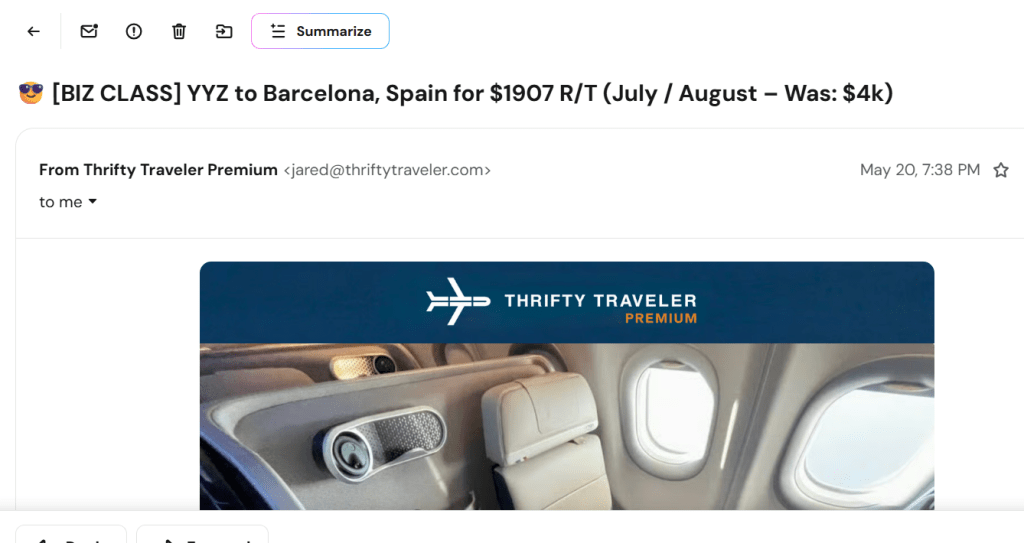
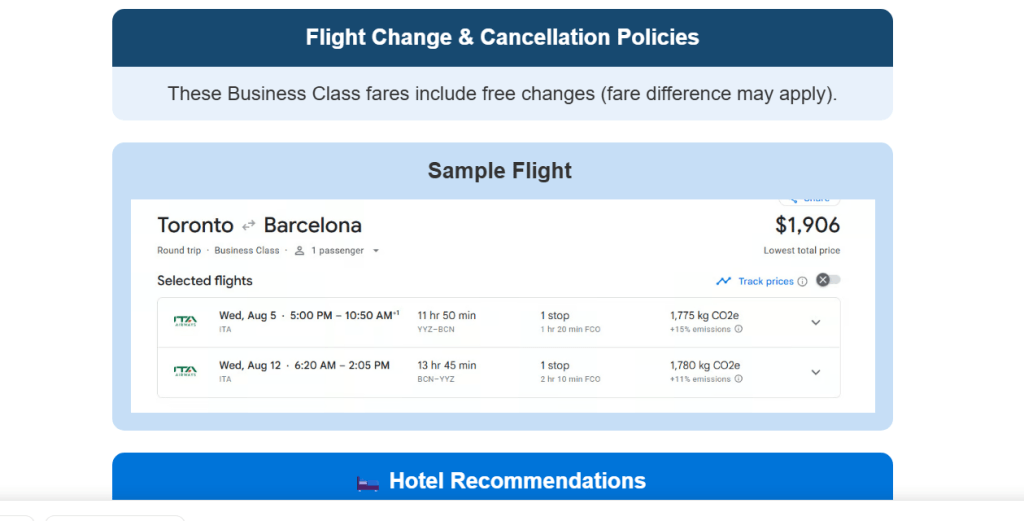
A recent example of a Thrifty Traveller alert includes a recent almost half price Business Class deal from Canada to Barcelona with ITA Airways
Strategy 2: Mistake Fares – Real, Rare, and Requires Speed
Mistake fares are exactly what they sound like: a pricing error by an airline or booking system that lists a business class seat at a fraction of its correct price. Think £400 return to Singapore in business class instead of £4,000. They happen. I’ve seen them. Some of them ticket and travel without issue.
The caveats are important:
The honest reality of mistake fares:
- They are genuinely rare: perhaps a couple of truly significant ones per year that affect UK-originating routes
- They close fast — often within two to four hours of being spotted. Sometimes less.
- Airlines are not legally obligated to honour them in the UK, though many do in practice to avoid the PR damage of mass cancellations
- Booking on a credit card gives you some protection if the airline cancels the ticket; non-refundable tickets booked on a debit card leave you more exposed
- Do not book non-refundable connecting travel (hotels, other flights) until the mistake fare ticket is confirmed and has been issued a valid ticket number (13-digit e-ticket)
Where mistake fares get spotted:
- Jack’s Flight Club premium tier
- Secret Flying
- Thrifty Traveller
- The Frequent Miler and Doctor of Credit (US-focused but UK readers benefit when mistake fares affect transatlantic routes)
- Flyertalk forums — the OG source, still active for significant mistake fare alerts
- Reddit: r/flightdeals
The last notable mistake fare I managed to book was a exciting Business Class return trip to Brazil back in 2023 with Iberia for just over £800 – after booking and getting ticketed, Iberia still sent cancellation notification, with a downgrade to Economy and peace offer for inconvenience. I decided to pull out for a full refund instead.
However in the same year, an Iberia Business class fare to New York, this time filed by British Airways for under £700 return – was booked and honoured and I’ve reviewed my trip here: Iberia Business Class to New York
Strategy 3: The Bidding Upgrade – More Achievable Than You Think
Several major airlines now run formal upgrade bidding programmes, essentially an auction where you name your price for an unsold premium seat. This is one of the most underused routes to business class for UK travellers, particularly because the winning bids are often far lower than people expect.
Airlines currently running upgrade bidding programmes:
- Virgin Atlantic – allows you to bid for a next cabin upgrade for eligible bookings. If successful, you will be notified and issued a new ticket in the high cabin.
- Etihad – their bidding system is one of the most developed. I’ve personally had success bidding from Business Class to First Class Apartments on Etihad. My full guide on how to upgrade your flight covers the Etihad system in detail including the bid strength indicator (dark red to dark green) and the fact that minimum bid amounts tend to increase closer to the flight.
- Lufthansa — runs a “MyOffer” upgrade bidding system. Generally well-regarded.
- Air New Zealand — “OneUp” bidding, one of the more transparent systems with good disclosure on bid ranges
- SAS — “SAS Upgrade” bidding, particularly active on long-haul routes
- Aer Lingus — their “Upgrade Yourself” system is worth knowing about specifically for the Dublin positioning angle (more on that below)
- Emirates — more selective, but upgrade opportunities do appear
- Singapore Airlines — KrisShop upgrade bidding, less widely known
How to bid effectively:
The key insight that most guides miss: the bid strength indicator exists to encourage you to bid higher. The actual clearing price — the amount that wins — is almost always lower than what the “strong bid” indicator suggests you need. Airlines have an incentive to present your current bid as weaker than it is.
Practical approach:
- Bid just above the stated minimum for a first attempt
- If rejected, you’ll often get a counteroffer or be given another chance before departure ( if you’re departure is more than a week away )
- Routes with lower load factors (midweek long-haul, shoulder season) have meaningfully better success rates
- Business class availability in the cabin you’re bidding into must technically exist, but airlines sometimes release extra seats specifically for bid upgrades that wouldn’t show as award or cash availability
The important caveat on upgrade perks: As I covered in my upgrade guide, winning a bid upgrade doesn’t always carry all the benefits of a purchased business class ticket. Emirates upgrade winners don’t get lounge access unless their original ticket included it. Turkish Airlines allows lounge access for miles upgrades booked in advance but not cash bid upgrades at the airport.
Always check the specific airline’s policy before bidding if the lounge is part of your calculation.
My Etihad bidding from Business Class to First Class was an offer I initially rejected about a month out – this was due to the minimum bidding amount being quite pricey, I did not consider it so much as a deal. However, a week before departure, I was able to bid for individual segments, and the pricing was much more reasonable and so I bid about 10% above the minimum, and got to enjoy First Class !
Strategy 4: The Positioning Flight, Avoid UK Air Passenger Duty
This is one of the most genuinely impactful strategies for UK travellers and one of the least discussed outside of frequent flyer communities. It requires a small amount of extra effort and adds some travel time, but the savings on long-haul business class can be substantial.
The problem: UK Air Passenger Duty (APD)
The UK charges Air Passenger Duty on flights departing UK airports. In business and first class, this adds a significant premium, currently around £300–600+ per person depending on the destination band, on top of whatever the airline charges. For a return long-haul business class ticket, APD can add £400–800 to the total cost compared to the same ticket departing from a non-UK airport.
The solution: position yourself to a non-UK departure point
By taking a short economy flight or train journey to depart from an airport outside the UK, you avoid APD entirely. The most practical options for UK travellers:
- Dublin (DUB) the classic move. A Ryanair or Aer Lingus flight from almost any UK airport to Dublin costs £50–80 – even with baggage added on, and Ireland doesn’t charge equivalent departure taxes. From Dublin, Aer Lingus flies transatlantic business class (Aer Lingus Business on the A321XLR to North America is a new and interesting product). Crucially, other airlines’ fares departing Dublin are often cheaper than equivalent fares from London independent of the tax saving.
- Amsterdam (AMS) — accessible by train from London via Eurostar (no flight needed, no APD applicable), and KLM’s network from AMS is extensive. Dutch departure taxes exist but are significantly lower than UK APD on premium cabins.
- Oslo or Stockholm ( ARN) – similar cheap Ryanair fares available, the flights are slightly longer here but the savings can be substantial.
- Paris CDG — Eurostar from London St Pancras in around two and a half hours. Air France’s network from CDG is vast, and their business class product on long-haul is genuinely excellent. French departure taxes are lower than UK APD on premium.
- Brussels (BRU) — Eurostar option, similar logic. Brussels Airlines and connections to Star Alliance carriers.
The maths on Dublin specifically:
A business class fare to New York from London might be £2,800. The same airline’s fare from Dublin might be £2,200 — before accounting for the APD saving. Add a £50 Ryanair flight to Dublin and a night in an airport hotel if needed, and you’re potentially £500–600 better off. On a more expensive route — say, business class to Tokyo or Sydney — the saving is proportionally larger.
When it makes sense and when it doesn’t:
The positioning approach works best when:
- The cash saving exceeds £300 (the point at which the extra travel day and positioning costs are clearly worth it)
- You have flexibility to depart a day earlier
- Connection times are reasonable and SAFE – see below
- You’re a solo traveller or couple (the maths scale with party size)
- The non-UK departure point has a better airline or routing option for your destination anyway
It makes less sense for short-haul business class within Europe, where APD is lower and the positioning cost relative to the total fare is higher.
I’ve personally done this many many times with departures from Paris/Amsterdam and even Milan. But it was my Singapore Airlines Business Class deal from Frankfurt to Singapore that should act as a cautionary tale – a flight I almost missed !

A major thing to note here is that you have plenty of time between your positioning flight ( and any potential delays ) and the departure of your main flight. I learnt my lesson in the most gut wrenching way, which I’ve documented: The risks of booking same day positioning flights
Strategy 5: Off-Peak Timing, When Airlines Discount to Fill Empty Cabins
Business class cabins fill from two distinct groups: corporate travellers (who book late and pay full fare) and leisure travellers (who are price-sensitive). Airlines set their pricing to maximise revenue from both — which means off-corporate-travel periods are consistently when the best cash fares appear.
The windows where business class is genuinely cheaper:
- January and February — the quietest months in long-haul travel. Corporate bookings drop after the Christmas period. Airlines discount heavily to maintain load factors.
- Shoulder season for your destination — not just UK school term times, but the destination’s off-peak. Southeast Asia during monsoon season. The Caribbean in hurricane season (September–November). These periods have meaningfully lower fares for travellers who don’t mind the risk.
- Midweek departures Tuesday and Wednesday departures are consistently cheaper than Friday and Sunday on most routes. For business class specifically, avoiding peak corporate departure days (Sunday evening, Monday morning, Friday afternoon) can drop fares noticeably.
- Red-eye and inconvenient departure times — long-haul flights departing at 01:00 or 02:00 AM are less popular and price accordingly. For overnight flights where you plan to sleep anyway, the departure time is largely irrelevant.
Strategy 6: Business Class Lite – Know What You’re Actually Buying
Before you book any discounted business class fare, there’s a critical caveat that I covered in depth in my guide to Business Class Lite fares — and it’s one of the most important things to understand when buying discounted premium tickets.
Many of the cheapest business class fares are now “Lite” fare buckets that strip out benefits you might assume are included:
- No advance seat selection (or paid only)
- No lounge access (the most stinging omission on a long-haul journey)
- Reduced baggage allowance
- Fewer miles or tier points earned
- No upgrade eligibility
The headline price looks like business class. The actual experience can be meaningfully different, particularly on the ground.
The airlines doing this most aggressively (as of 2026): Qatar Airways Business Lite, Finnair Business Lite, Emirates “Business Class Special” fares (which function as Lite in practice), Lufthansa Light Business fares, and increasingly Air France on some routes.
How to spot a Lite fare before you book:
- Look at the fare conditions carefully — “seat selection from check-in only” is the clearest signal
- Check whether lounge access is included as a written benefit, not just assumed
- Compare the fare code against the airline’s published fare rules if you can find them
- On the airline’s own site, Lite fares are often labelled differently — “Flex Lite”, “Business Saver”, “Light” — and usually come with an explicit list of what’s excluded
Watch out for baggage allowance in particular – if you are embarking on a major trip and won’t travel super lite – Finnair in particular often has deals to Asia with no checked baggage at all. This is mitigated if you have oneworld Sapphire status or above.
The verdict on Lite fares: They’re not inherently bad value, particularly on shorter long-haul routes where the lounge and seat selection matter less, or where you already have lounge access through a credit card or status. But buying one unknowingly, expecting the full business class experience, is one of the most common and expensive mistakes in premium travel. Always read the fare conditions before booking a discounted business class ticket.
Strategy 7: Using Points Strategically Alongside Cash – The Hybrid Approach
This guide is primarily about cash and deals strategies, but there’s one scenario where the points and cash worlds overlap meaningfully: when a cash sale fare is actually better value than a points redemption.
This is more common than the points community acknowledges. During the BA Spring 2023 sale, Club World fares to New York were available at prices that, when compared against the Avios cost of the same route (160,000 Avios + £350 in taxes), made the cash fare genuinely better value — particularly if you valued your Avios at more than 1p each for future redemptions.
The principle: Points have a value. When a sale fare is cheap enough that the cash equivalent of the points you’d spend exceeds the cash price, buy the cash ticket and save your points for a redemption where no sale equivalent exists.
When to use cash:
- Airline sale fares to popular routes (US, Europe, Caribbean) during genuine promotional periods
- Routes where your preferred programme charges heavy surcharges anyway (BA own-metal long-haul)
- When you need to earn status points or miles from the flight itself (award tickets typically earn poorly)
When points win:
- Routes with no meaningful cash sale equivalent (Singapore, Tokyo, Sydney in business class rarely go on deep sale from the UK)
- First class (almost never on genuine cash sale)
- When a promotional points rate or transfer bonus makes the redemption cost dramatically lower than usual
I’ve written extensively about flying British Airways Club World/Suite via the use of Barclays Upgrade Vouchers. There are sales where this upgrade voucher value is beaten by an outright cash fare. In which case, you should save your upgrade voucher for a route where there is no sale.
The Tools Worth Bookmarking
A quick reference of everything mentioned in this guide, plus a few extras:
Finding sale fares directly:
- BA sale page — britishairways.com/travel/salefares
- Virgin Atlantic offers — virginatlantic.com/offers
- Qatar Airways promotions — qatarairways.com
General flight search:
- Google Flights — google.com/flights
- Skyscanner — for multi-airline comparison including regional UK airports
- ITA Matrix (matrix.itasoftware.com) — advanced fare search, used by travel agents; shows fare codes and routing rules that consumer sites hide
The Honest Summary
The cheapest ways to fly business class in 2026 is not one strategy, it’s knowing which of these approaches applies to your specific trip, and having the flexibility to use the right one.
If you’re booking six months out to a popular route during a known sale window, catch the airline sale. If you’re a solo traveller with date flexibility and the route has significant APD exposure, position via Dublin or Amsterdam. If you’re already booked in economy and the flight has low load factors, put in a bid. If you’ve been collecting Avios or Virgin Points and the points cost genuinely undercuts any cash sale — use the points.
The travellers who consistently fly business class for a fraction of the published price aren’t doing one clever thing. They’re maintaining optionality across all of these approaches and deploying whichever makes sense for each trip.
A final word of warning, the airline fares and pricing are constantly evolving ( and the direction is almost always up ) so your base point of what constitutes a deal/good price point will always evolve along with the realities of the wider economy. For many years my golden rule for a good transatlantic Business fare was just under the £1000 mark. Today, that is currently sitting at £1500. We are in a new reality.
Related Reading
- How to Fly Business Class with Points — The UK Guide
- Business Class Lite Fares: What You Need to Know
- How to Upgrade Your Flight in 2026
- How to Use Google Flights
- Best Avios Sweet Spots for Business and First Class
- 10 Best Value Virgin Points Redemptions

Faze, founder of Wander Up Front and Elevate Your Stay, is a London-based travel specialist with a deep passion for aviation and unique destinations. With over 2 million miles flown, he has spent the last 8 years focusing on First and Business class experiences and travelled to 99 countries.
Faze provides straightforward, no-frills insights into premium airline products and services, sharing what matters to help travellers make informed choices.
Follow him on his adventures and behind the scene stories on Instagram !
If you want to want to travel in style in more cost affective ways – check out his starter guide to utilizing Miles & Points