


How to Fly Business Class with Points UK Guide (2026)
Updated on June 12th, 2026 at 12:03 pm
The Flight that CHANGED Everything
Back in 2018, I’d been collecting Avios casually for a few years – not seriously, not strategically, just letting them accumulate on a BA card and forgetting about them. Then a friend told me he’d just flown Singapore Airlines Suites, the real thing…
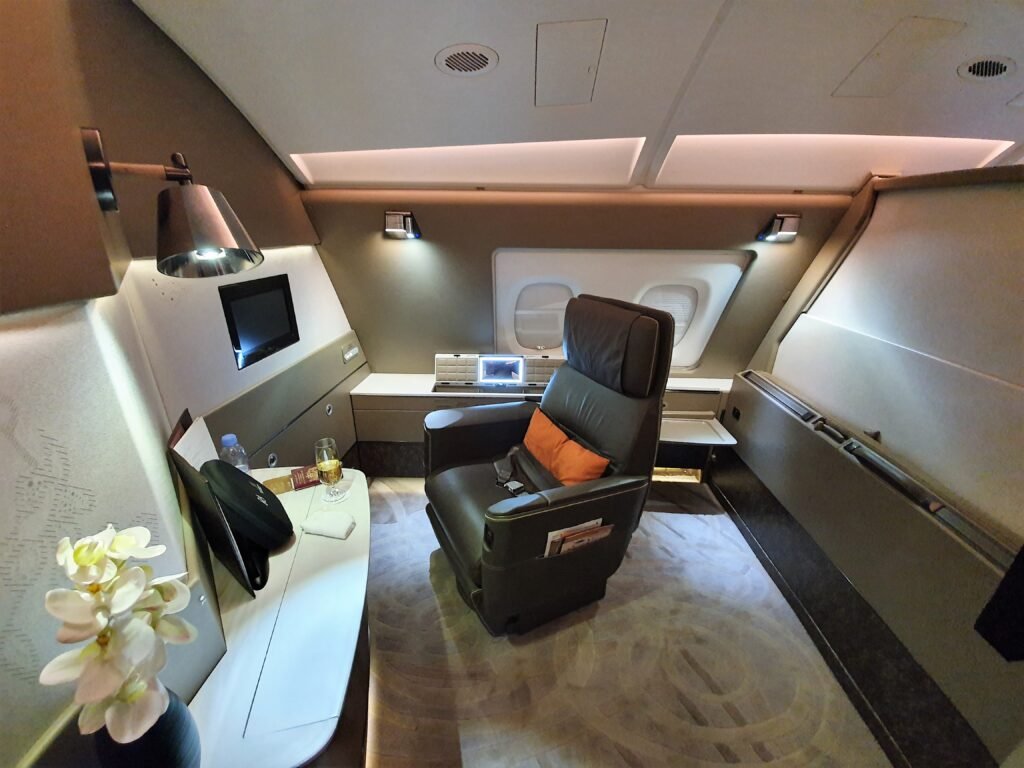
Six enclosed first-class compartments on the upper deck of the A380. Not only that but for a fraction of the cash price, using KrisFlyer miles he’d transferred from an Amex card.
I didn’t believe him.
So I looked it up. And then I started digging. I completely fell down the rabbit hole that I’ve never climbed back out of. Not only did I realize I had the WRONG Amex card for this, which was quickly corrected, more some else more profound happened. A complete SHIFT in how I thought about points.
Admittedly, I was somewhat late to the game. It was frustrating thinking I’d already spend many thousands on flights prior years ( including the occasional Business Class treats ) without taking any advantage of the best options available. But better late than never eh?
That was the moment I understood what points are actually for. Not for a free economy seat to Edinburgh or Barcelona. Not for an upgrade to premium economy if you’re lucky. For the kind of travel that, if you paid cash, would cost £5,000, £8,000, sometimes more, booked instead for the price of a couple of strategic credit card sign-up bonus and a bit of patience.
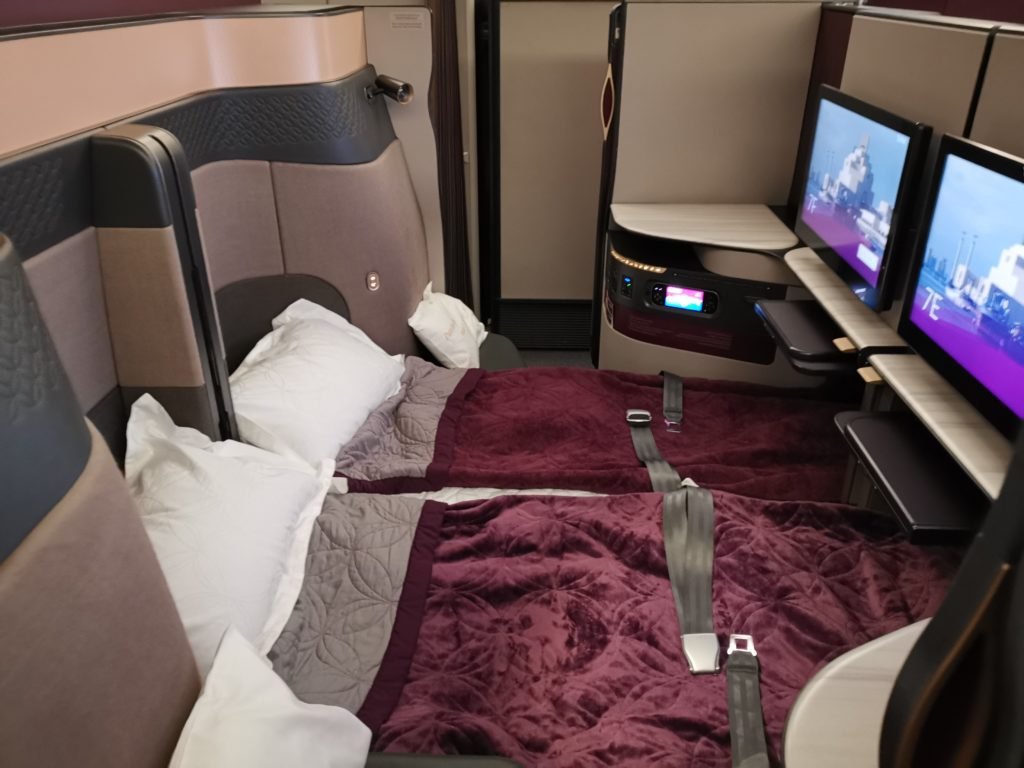
Over FIVE million miles later, I’ve flown that dreamy Singapore Suites, Etihad First Class Apartments, Emirates Game Changer, and dozens of business class products across the world, at least half of them on points.
This guide is everything I wish someone had told me at the beginning.
First: What “How to Fly Business Class with Points UK” actually means
Points and miles aren’t a loyalty trick. They’re a parallel currency – one with genuinely extraordinary exchange rates when you use them right.
Here’s the basic mechanic: airlines set aside a portion of their business class seats as award seats, available to redeem with points or miles rather than cash.
The cash price of a business class seat from London to Singapore might be £4,000–£6,000. The points price for the same seat, through the right programme, might be 60,000–90,000 miles per way – miles you can earn through credit card spending, transfer bonuses, and everyday purchases.
Done well, you’re extracting 4–8p of value from every point you’ve earned at 1–2p. That gap is where the magic lives.
There are three pieces to making this work:
- Earning — accumulating points in the right currencies
- Transferring — moving points to the airline programme that has the seat you want
- Booking — finding award availability and completing the redemption
One thing I won’t sugar coat: taxes and carrier surcharges are real, and they’re getting worse.
The era of genuinely “free” flights that some in the points community used to boast about? Largely gone. As anyone with a basic grasp of economics will tell you, there’s no such thing as a free lunch – and the points game, I believe at its core, is a zero-sum one. For every person extracting outsized value, someone else is absorbing the cost. It’s a moral dimension I’ve thought about a lot, and frankly one reason I’ve never made points & miles a core identity of this site.
What I will say is this: some programmes are significantly more transparent and traveller-friendly than others when it comes to surcharges. Knowing which ones to avoid — and which to lean into — is half the battle. More on that shortly.
Step 1: Build your points BASE – start with Amex Gold
If you’re starting from zero, there is one move that makes more sense than anything else for UK readers: get the American Express Membership Rewards Gold card. If you apply with my referral, you will currently get a massive 35,000 points welcome bonus !

I’m not saying this lightly. I’ve looked at every major UK travel card, and for most people, not everyone, but most – Amex Gold is the right first move. Here’s why.
Amex Membership Rewards (MR) points are what’s called a transferable currency. Unlike Avios earned directly on a BA card, or Virgin Points earned on a Virgin card, Amex MR points aren’t tied to one airline. You can transfer them to:
- Avios (British Airways Executive Club) — 1:1
- Virgin Points (Flying Club) — 1:1
- Flying Blue miles (Air France/KLM) — 1:1
- Marriott Bonvoy, Hilton Honors, and other hotel programmes
This flexibility is the key advantage. You earn once, and then decide later which airline has the seat you want. Compare that to a co-branded BA Amex, perfectly good card, but every point you earn is already committed to the BA ecosystem whether that works for you or not.
The Gold card also typically carries a meaningful welcome bonus (check the current offer — these change, and it’s often the single fastest way to build a meaningful balance quickly). The annual fee is waived in year one on most offers.
What about Amex Platinum? It’s a better card for serious, high-volume travellers — lounge access, travel insurance, and a higher earn rate on some categories. But the annual fee is significant. For most people beginning this journey, Gold first, Platinum later if your travel habits justify it.
What about a BA Amex? If you know with certainty that you only ever want to fly BA-operated flights and use Avios directly, the BA Premium Plus Amex is genuinely excellent — especially for the companion voucher, which I’ll come to. But as a starting point for flexibility? Amex Gold wins.
Step 2: Understand your THREE Main Currencies
Once you’re earning Amex MR, you have access to three programmes that matter most for UK readers booking business class. Here’s what each one is actually good for.
Avios: the workhorse
Avios is the shared currency of the IAG group: British Airways, Iberia, Aer Lingus, Vueling, and more. One Avios pot, multiple airlines to book through.

What Avios is genuinely great for:
- Short-haul European business class — you can fly Club Europe (proper business class with meal service and a blocked middle seat) for as few as 10,000–15,000 Avios one-way in off-peak periods. Cash equivalent: often £300–600.
- Long-haul on partner airlines — booking Qatar Qsuites, Japan Airlines, Cathay Pacific First, and others through the BA Executive Club using Avios
- The Companion voucher — spend £15,000 on the BA Premium Plus Amex in a year and you earn a voucher to book a second reward seat for just the taxes. On a long-haul business redemption that’s potentially saving you 100,000 Avios
- For more see my full Avios Redemptions Sweet Spot Guide
How Many Avios Needed For Business Class?
If you are trying to figure out how many Avios you need to book a Business Class seat with BA, I have a handy quick calculator right here – BA Avios Needed Calculator
Where Avios has weaknesses:
- Carrier-imposed surcharges on BA’s own long-haul flights can be painful — expect £400–700+ in taxes even on a “free” seat
- To avoid surcharges, book partner airline flights through BA (Qatar, Japan Airlines, Finnair) rather than BA itself
- Availability on popular routes and dates can be frustratingly limited, particularly for long-haul BA metal
The Iberia angle: A often-overlooked play is booking through Iberia Plus instead of BA Club — same Avios, but Iberia charges far less in taxes on many routes, and sometimes prices partner awards differently. Worth checking both.
My honest take: With 50,000-75,000 Avios, I’d look at Qatar Qsuites to Doha, a Cathay Pacific business class redemption to Hong Kong, or Club Europe returns across Europe on a companion voucher. Avios gives you more routes and more flexibility than any other single programme available to UK readers.
Virgin Points – The sweet spots programme
Virgin Atlantic’s Flying Club has some of the most interesting sweet spots in the points world, particularly for partner airline redemptions. The programme has expanded significantly since Virgin joined SkyTeam in 2023.
What Virgin Points excels at:
- Upper Class London–New York — from around 29,000–37,500 points in off-peak periods under the dynamic pricing model
- Delta One to Europe — 50,000 points, often cheaper than booking Delta flights with Delta SkyMiles directly
- Air France/KLM business class — Virgin still prices some of these at 48,500 points when Flying Blue itself charges 60,000 of its own miles
- You’ll see ANA First Class via Virgin Points cited everywhere as the ultimate sweet spot. The reality in 2026 is that pricing has increased significantly and availability is so restricted, especially out of UK, it’s barely worth pursuing for most readers. I’ve deliberately left it out.
- Here’s my favourite Virgin Points redemptions
The dynamic pricing caveat: Virgin moved to dynamic pricing for its own flights in late 2024. This means redemption rates fluctuate — the 29,000-point Upper Class seat exists, but isn’t guaranteed on your dates. The partner sweet spots still use fixed pricing and are more predictable.
Taxes: Virgin redemptions on Virgin-operated flights come with meaningful UK Air Passenger Duty and carrier charges — £600+ from London in some cases. The Delta/ Air France partner redemptions tend to carry lower surcharges, which is part of why they’re so compelling.
My honest take: When you see a Virgin Points redemption as those lower SAVER rates – JUST BOOK IT. It will be gone before you finish your tea ! For most UK readers on common routes, Avios offers more day-to-day utility. Virgin Points shine brightest on specific, high-value partner redemptions — they’re not as versatile as a day-to-day currency.
Flying Blue: the underrated option
Air France/KLM’s Flying Blue programme is genuinely underappreciated by UK readers, and worth having in your toolkit even if it’s not your primary currency.
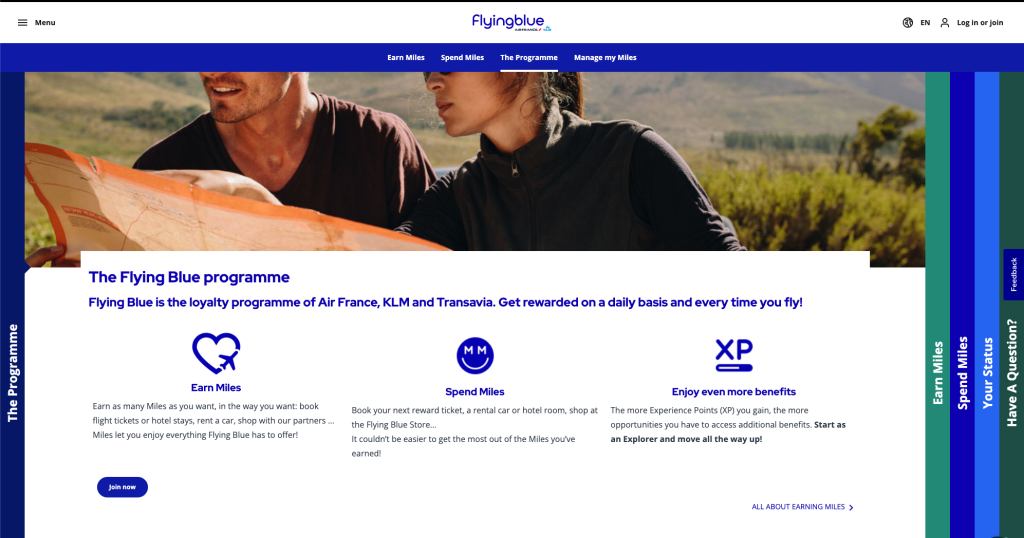
Why Flying Blue matters:
- Monthly Promo Rewards — every month, Flying Blue releases a selection of routes at 25–50% off the standard miles price. Business class to New York, the Caribbean, Southeast Asia — these promos can make Flying Blue competitive with anything else on the market for specific routes and months
- Lower carrier surcharges on many redemptions, unlike BA’s own long-haul flights
- Hub flexibility — Paris CDG and Amsterdam AMS open up connection options that BA can’t match
- My favourite Flying Blue Business Class Redemptions
The catch: Flying Blue uses dynamic pricing, so the “standard” rate for a business class seat varies. The promo awards are fixed-price and where you find the real value — but they’re date and route specific, requiring flexibility.
My honest take: I don’t use Flying Blue as my primary programme, but I check their monthly promos religiously. If a promo lines up with a trip I’m planning, it can dramatically undercut what Avios or Virgin would charge for the same seats. Worth having the programme, worth checking the promos every month.
Step 3: The three things that actually unlock business class
Most guides give you the theory and leave you here. But in practice, the readers who successfully book business class with points do three specific things that others don’t. These aren’t secrets — but they’re consistently understated.
1. Book early — 355 days for BA, as soon as available for others
British Airways releases Avios reward seats — particularly partner airline seats — up to 355 days before departure. The best availability, on the best routes and dates, almost always appears at this point. Waiting until six months out means working with whatever’s left.
For most other programmes (Flying Blue, KrisFlyer, ANA Mileage Club) the booking window varies — typically 330–360 days. The principle is the same: the earlier you search, the more you’ll find.
I know this is frustrating for people who don’t plan that far ahead. But it’s the honest answer. If you want a specific cabin on a specific airline on a popular date, the 355-day mark is when you need to be looking. Set a calendar reminder.
2. Be flexible — on dates, on routing, on airline
The readers who struggle to find availability are usually searching for a specific airline, on specific dates, to a specific airport. The ones who actually book business class are willing to move any one of those variables.
Practical examples of what flexibility unlocks:
- Flying Thursday instead of Friday can double the available seats
- Connecting via a hub (Doha, Dubai, Singapore) instead of flying nonstop often opens up a completely different airline’s inventory
- Departing from Paris or Amsterdam instead of London means accessing Air France and KLM’s home airport inventory — sometimes far easier to book, and potentially avoiding UK Air Passenger Duty
- Flying outbound on Avios but returning on Flying Blue — mixing programmes across a trip is completely fine and often the best approach
3. Watch for transfer bonuses — especially if you have US-linked accounts
Transfer bonuses — where a credit card programme gives you, say, 30% extra miles when you transfer to a specific airline — are less common in the UK than they are in the US. But they do happen. Virgin Atlantic in particular has run transfer bonuses from Amex MR, and the US programmes (Chase, Citi, Capital One) regularly run 30–40% bonuses to Virgin, Flying Blue, and others.
If you have any US credit card accounts or travel frequently to the US, keeping an eye on transfer bonuses can meaningfully reduce the cost of a premium redemption. A 30% bonus effectively makes a 50,000-point redemption bookable with 38,500 points — that’s the difference between having enough and not.
In the UK, the most consistent play is timing your Amex MR transfers to coincide with any active bonus promotions before you book, rather than transferring points in advance and letting them sit idle in an airline programme.
Step 4: Find the seats
You have your points. You’ve chosen your programme. Now you need to find actual award availability. This is where many people give up — but with the right tools, it’s very achievable.
Search directly on the airline’s website first. BA.com, virgin.com, airfranceklm.com — all have award search tools. For BA/Virgin in particular, the award search is reasonably good and shows partner availability. Always start here.
Use SeatSpy for BA award alerts. SeatSpy monitors BA reward seat availability and alerts you when seats open up on routes you’ve set. For busy routes where you’re not booking at the 355-day mark, this is invaluable — cancellations and seat releases happen constantly, and SeatSpy catches them in near real time.
Use seats.aero for a broader view. This tool searches award availability across multiple programmes simultaneously — useful when you’re not committed to a specific currency and want to see which programme has seats on your route.
Be persistent, not frantic. Availability fluctuates. Airlines release unsold premium seats closer to departure — sometimes within two weeks of the flight. If you haven’t found what you want at the 355-day mark, set an alert and check periodically. It’s not uncommon to find excellent availability open up 14–30 days out.
Business Class vs First Class — what’s the difference, and which should you aim for?
This is a question I get asked constantly, and my honest answer is: it depends on the airline, and what matters most to you.
In 2026, the best business class products — Qatar Qsuites, Singapore Airlines Business Class, ANA The Room — are extraordinary. Enclosed suites, double beds for couples, dine-on-demand, champagne lists that would embarrass most restaurants. The gap between business and first class has narrowed significantly on the best carriers.
But First Class does offer something different: a smaller, more exclusive cabin, typically more attentive crew ratios, superior dining and bedding on most airlines, and a ground experience (dedicated check-in, First Class lounges, sometimes chauffeur transfers) that business class doesn’t quite replicate.
The practical consideration with points: First Class award seats are significantly rarer than business class seats. Airlines release far fewer of them, and on some routes they’re almost never available as award redemptions regardless of how many points you have. Business class availability is meaningfully better.
My suggestion for where to start: Target the best business class products first — Qatar Qsuites, Singapore business on the A350, Cathay Pacific in Aria Suite, JAL business on new A350. These are legitimately extraordinary experiences that will redefine what air travel means to you. First Class can be a chapter two, once you’ve understood how the points game works and built the flexibility to hunt for rarer availability.
The Companion Voucher — one thing UK readers should never overlook
If you hold the British Airways Premium Plus American Express card and spend £15,000 on it in a membership year, you earn a Travel Together Ticket — a companion voucher that lets you book a second reward seat on the same flight for just the taxes and fees.
In practice: one person’s 120,000-Avios business class booking to Singapore gets you two seats. You pay taxes twice (which can be significant on BA metal, though less so on partner airlines), but the second seat itself is essentially free.
For couples, this changes the maths of the entire exercise. The £300 annual fee on the BA Premium Plus Amex pays for itself many times over the moment you use the voucher on a meaningful redemption. It’s one of the most genuinely valuable benefits in UK travel credit cards, and it’s consistently underutilised.
The honest caveats – what this guide won’t pretend
Points programmes devalue. They have done historically, and they will again. The Avios chart repriced upward in December 2025. Virgin has adjusted its dynamic pricing model. Flying Blue’s rates fluctuate. The value available today is real, but it isn’t guaranteed to remain at these levels.
The response to this isn’t to avoid the programmes — it’s to earn with a redemption in mind rather than stockpiling speculatively. Accumulate towards a specific trip, transfer and book when you have enough, and don’t let large balances sit idle for years while you wait for the “perfect” opportunity.
The other honest caveat: this takes some patience and planning. The readers who find it frustrating are usually the ones who decided they want to fly business class next month and are trying to make it work retroactively. The ones who find it transformative are the ones who plan 6–12 months ahead or in some cases last-minute, build their points deliberately, and treat finding the seat as part of the experience.
Quick-start summary
If you want to distil this into a starting sequence:
- Apply for the Amex Gold card — earn the welcome bonus, put your everyday spending on it – my special referral will currently earn you a whopping 35,000 points bonus ! It is normally just 20,000 !
- Join BA Club (free) and link your Amex MR account so you can transfer when ready
- Join Virgin Flying Club (free) and Flying Blue (free) — you want the accounts open before you need them, as transfers can take a few days
- Set a destination — pick a specific trip you want to take, and work backwards from the points cost
- Search availability at 355 days — use BA.com, SeatSpy, and seats.aero to understand what’s available on your route
- Transfer and book — only transfer points once you’ve confirmed seat availability. Never transfer speculatively.
See all my other reward Cards with extra referral bonus
The first redemption is the hardest. After that, the system becomes second nature – and flying in a seat that costs £5,000 on points you earned buying your weekly shop never really gets old.

Faze, founder of Wander Up Front and Elevate Your Stay, is a London-based travel specialist with a deep passion for aviation and unique destinations. With over 2 million miles flown, he has spent the last 8 years focusing on First and Business class experiences and travelled to 99 countries.
Faze provides straightforward, no-frills insights into premium airline products and services, sharing what matters to help travellers make informed choices.
Follow him on his adventures and behind the scene stories on Instagram !
If you want to want to travel in style in more cost affective ways – check out his starter guide to utilizing Miles & Points