
United vs American Airlines: Which Is Better in 2026?
Updated on August 14th, 2026 at 07:00 pm
United or American? Both are founding members of their respective global alliances, both operate over 350 destinations, and both are competing harder than ever for the premium transatlantic and domestic traveller. But fly enough time and the differences become clear: different hubs, different fleet strategies, different lounge philosophies, and meaningfully different loyalty programmes.
I have flown both airlines many times across the Atlantic and within the USA, including United Polaris and American Flagship Business in long-haul business class. This is my honest 2026 comparison across every category that matters, from seats and lounges to reliability and the best way to redeem points on each carrier.
The premium products for are competitive and at the top end of their Suites – very similar. I do think United offers a more compelling soft product, but then it fails miserably with catering, where American does a much better job.
United vs American Airlines Quick Verdict
United wins on international network depth, business class product consistency and, with its new 787 fleet entering service, the direction of travel for its hard product. American wins on loyalty programme value through AAdvantage, its Latin America dominance and the quality of its Flagship Lounges across a broader airport network.
On reliability, United has a meaningful and growing edge over American.
| Category | United Airlines | American Airlines | Winner |
|---|---|---|---|
| Business class hard product | United Polaris (Saffran shell) | Flagship Suites / Flagship Business | Tie (fleet dependent) |
| Business class consistency | Polaris across all widebody fleet | Mixed (Flagship Suites still rolling out) | United |
| Premium economy | United Premium Plus | AA Premium Economy | United (consistency) / AA (recline) |
| Lounges (premium) | Polaris Lounges (5 locations) | Flagship Lounges (broader network) | Tie |
| On-time performance (2024) | 80.9% | 77.8% | United |
| Cancellation rate (2024) | 1.34% | 2.00% | United |
| Loyalty programme | MileagePlus (Star Alliance) | AAdvantage (oneworld) | American (partner award value) |
| Latin America network | Strong via Houston | Market leader | American |
| Asia-Pacific network | Stronger (via Star Alliance partners) | Good via JAL and Cathay (oneworld) | United |
| Amenities and bedding | Saks Fifth Avenue / Away amenity kit | Casper bedding / Shinola kit | United |
Network and Routes
American and United are surprisingly well-matched on network size, but their geographic strengths sit in different places.
American operates around 350 destinations across 60 countries, with its key hubs at Dallas/Fort Worth, Charlotte, Miami, Phoenix and Philadelphia. Its Miami hub gives it an unrivalled presence in Latin America and the Caribbean, flying more routes to Mexico, Central America and South America than any other US carrier. For domestic US travel, American’s fortress at Charlotte and its strong presence at DFW make it a dominant choice in the south and southeast.
United operates around 300 to 360 destinations globally and recently became the world’s largest airline by fleet size, with over 1,000 mainline aircraft. Its hubs at Newark, Chicago O’Hare, San Francisco, Denver and Houston give it an exceptionally strong position for international travel, particularly to Europe and Asia-Pacific. The Newark hub is United’s primary transatlantic gateway.
For Asia-Pacific routes, United holds a structural advantage. Its Star Alliance membership connects seamlessly with Singapore Airlines, ANA, Lufthansa Group and TAP, giving passengers more options across the Pacific than American’s oneworld partnerships with JAL, Cathay Pacific and (from 2026) Philippine Airlines and Oman Air can match in terms of sheer frequency.
Both airlines serve Europe extensively, though United’s frequency is slightly higher. For Latin America and the Caribbean, American wins decisively.
Business Class: United Polaris vs American Flagship
United Polaris Business Class
United launched its Polaris Business Class product in 2016 and completed the rollout across its entire widebody international fleet within six years, an impressive commitment to consistency. The seat is based on a Safran shell in a reverse herringbone configuration, with direct aisle access from every seat, a fully flat bed, and a distinctive dark blue design palette.
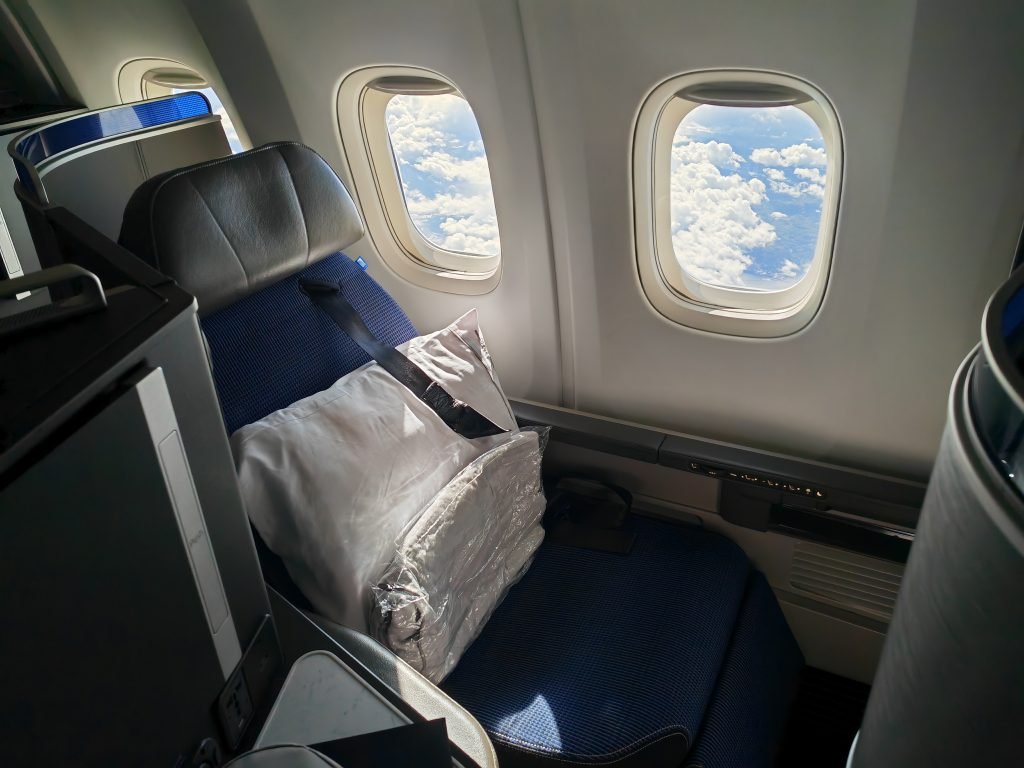
What Polaris does particularly well is privacy. True window seats offer an excellent level of enclosure without a door, and the overall layout feels more considered than many first-generation reverse herringbone products.
The IFE is the one area where Polaris laggs a little. The screens are small-ish and controllers dated at launch and, while the content selection is solid, the hardware feels its age on olde frames. United is addressing this with its new 787 Elevated configuration, which brings a 4K OLED screen to every seat and a significantly upgraded interior throughout.
The Polaris product on the 787-9 and 787-10 is meaningfully better one the whole but the United 767 Polaris is no slouch either – primarily due to the 1-1-1 layout creating a very spacious feel -this in my view helps United excel in areas where American and Delta struggle.
United is also introducing its next-generation business class seat on the Elevated 787, called Polaris Studio in the first rows of the cabin, which adds further privacy and more generous storage. This aircraft began service in 2026 and will reshape United’s premium offer considerably.
Score: 8/10 (current Polaris) / 9/10 (Elevated 787 with updated interior)
American Airlines Flagship Business and Flagship Suites
American’s business class in 2026 is a product in transition. Its existing Flagship Business seat, the Collins Aerospace Super Diamond on the 787 and 777-200 frames and the Safran Cirrus II on the 777-300ER, remains a competitive reverse herringbone with all the standard long-haul business class features.

The significant development is the new Flagship Suites, built on the Elevate Aircraft Seating Ascent platform, now deploying on the 787-9P subfleet and being retrofitted onto 777-300ER frames. This is the same seat shell as Qatar Airways Mini QSuites i’ve also flown.
These feature a full sliding privacy door, a 21-inch wide fully flat bed, a 17-inch 4K touchscreen, wireless charging and Bluetooth audio.

In terms of pure hardware, the Flagship Suite is the most impressive product American has ever flown and puts it on par with the better international carriers.
The Flagship Suites are currently on a limited number of routes including Dallas to Brisbane, Dallas to Auckland, and select transcontinental services. The rollout to additional transatlantic routes will continue through 2026 and 2027.
American’s consistency advantage over United is narrowing as Polaris ages, but United’s network-wide Polaris rollout means you are getting a known, competent product on any United widebody, whereas the American experience still varies considerably depending on which aircraft type you are assigned.
Score: 9/10 (Flagship Suites) / 7.5/10 (existing Flagship Business)
Business class verdict: United wins on consistency across the fleet right now. American wins at the top end if you can secure a Flagship Suites flight. United’s Elevated 787 will shift the balance further when it enters wide service.
Premium Economy: United Premium Plus vs AA Premium Economy
| Spec | United Premium Plus | AA Premium Economy |
|---|---|---|
| Seat pitch | 38 in (97 cm) | 38 in (97 cm) |
| Seat width | Up to 19 in | 18.5 – 19 in |
| Recline | Up to 6 in | Up to 8 in |
| Legrest / footrest | Yes | Yes |
| Typical configuration | 2-3-2 (787) / 2-2-2 (777) | 2-4-2 (777 / 787) |
| IFE screen | 16 in 4K (787) / 13.3 in (777) | 13.3 in |
| Wireless charging (new aircraft) | Yes | On 787-9P only |
| Privacy divider | Yes (new aircraft) | No |
| Available across widebody fleet | Yes | Yes |
United Premium Plus is the more polished premium economy offering in 2026.

The 2-2-2 configuration on the 767 means no middle seats at all in this cabin, which is a significant comfort advantage. On the 787 its 2-3-2 but with its 16-inch 4K screen, privacy divider and wireless charging, Premium Plus feels genuinely close to a premium product rather than an upmarket economy seat.

American’s Premium Economy reclines slightly more at up to 8 inches versus United’s 6, which is the one area where American pulls ahead on hardware. For an overnight transatlantic flight that extra recline is noticeable. The configuration on the 777 is 2-4-2, meaning the middle four seats have passengers on both sides, a less comfortable arrangement than United’s equivalent.
Both carriers offer priority boarding, two free checked bags and upgraded dining in premium economy. United’s amenity kit offering in this cabin is generally considered stronger.
Premium economy winner: American simply due to better recline, United offers a strong overall Premium product when all other dimensions are the same.
Domestic First Class
On domestic routes, American and United both offer a forward first class cabin with recliner seats in a 2-2 configuration on most mainline aircraft. The seat specs are broadly comparable: around 38 inches of pitch and 20 inches of width on typical mainline narrowbodies.
The biggest practical difference is IFE. United has been investing in seatback screens across its domestic fleet and offers screens on most mainline narrowbody aircraft. American has moved away from seatback screens on domestic narrowbodies, relying on in-flight streaming to personal devices. United wins this point clearly for passengers who want to watch films without pulling out their own device.
United’s Economy Plus, its extra-legroom economy product, deserves a mention for domestic travel. It offers 34 to 37 inches of pitch in the forward economy rows, a genuine comfort upgrade that is accessible to elite members and purchasable by anyone. American’s equivalent, Main Cabin Extra, is comparable but American allows eligible oneworld status holders including British Airways Gold and Platinum members to select Main Cabin Extra seats for free, a benefit that United does not extend to Star Alliance partners to the same degree.
For domestic first class meal service, both airlines serve meals only on flights over 900 miles. Shorter routes receive a snack basket. The quality is roughly comparable, though American’s partnership with the James Beard Foundation gives its longer domestic routes a small edge on food quality.
Lounges: Polaris vs Flagship vs United Club vs Admirals Club
United Lounges
United operates two lounge tiers. The United Club is available at most hubs and compares reasonably well with the Admirals Club: comfortable, functional, with adequate food and drinks. Some United Club locations have been through recent refurbishment and feel modern; others at Houston and some secondary hubs are more dated.

The premium offering is the Polaris Lounges, available at Newark, Chicago O’Hare, San Francisco, Los Angeles and Houston for passengers departing on United-operated international flights in Polaris Business Class.
The Polaris Lounge experience is exceptional: a la carte dining with waiter service, premium spirits, spa-like shower rooms, nap areas and generous, spacious seating. It is genuinely one of the better business class lounge experiences in North America and competes with the top international lounges.

Score: 9/10 (Polaris Lounge) / 6.5/10 (United Club)
American Airlines Lounges
American’s Admirals Club is a solid, broadly consistent lounge network covering most of its hubs and many international airports. It is not flashy but it is reliable, and card-based access makes it accessible to a wider range of travellers than the lounge-by-lounge model at some competitors.

The Flagship Lounges, available at JFK, LAX, Chicago, Miami, Dallas/Fort Worth, Philadelphia (new in 2025) and select international airports, are the premium tier. These offer champagne on arrival, chef-curated dining, an upscale bar and attentive service.

They are accessible to Flagship Business passengers on same-day international departures and to top-tier AAdvantage status holders. American’s Flagship Lounge network is broader than United’s Polaris Lounge network, which gives it an advantage for travellers who pass through multiple different hubs.
On top of that for the most Elite frequent flyers can also access the First Class level lounges such as Soho Lounge New York JFK and Chelsea Lounge JFK
Score: 9.5/10 (Flagship Lounge or Soho Lounge) / 6.5/10 (Admirals Club)
The United Polaris Lounge at its best is marginally better than the American Flagship Lounge, but American’s geographic spread means more passengers can access a premium lounge experience across its network and on top of that, there is the possibility of a First Class level lounge – even if not flying First Class, which United does not offer.
Catering
American wins this category over United without much contest. American’s James Beard Foundation partnership has elevated its international business class catering significantly, with a structured multi-course service, printed menus, and a well-stocked snack galley throughout the flight. The signature sundae cart remains a passenger favourite.

United’s catering has been improving and the carrier has invested in upgrading its Polaris dining programme, but the execution remains inconsistent. On the right route with a strong crew the meal service can be impressive, but United’s catering is not yet reliably at the level of American’s best flights.
United’s famous dessert cart is a genuine highlight and the Polaris dining programme at its best is excellent, but average-to-average American beats average-to-average United on food.
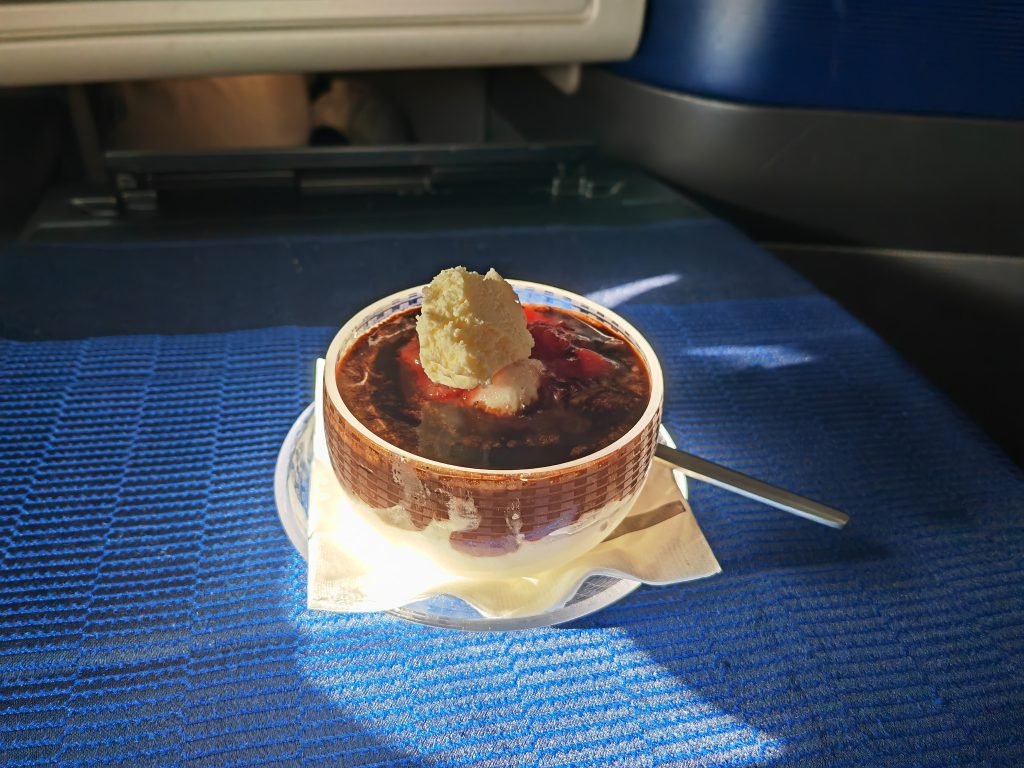
For domestic first class, the gap is smaller. Both carriers serve comparable meals on qualifying routes.
Despite many attempts to improve the situation – United is still below par with catering, though it is actually fairly decent out of London Heathrow !
Catering winner: American Airlines
Amenities and Bedding
United takes this category. Its Polaris Business Class partnership with Saks Fifth Avenue for bedding and Away for the amenity kit case produces one of the better sleep setups in US airline business class, with a genuine mattress topper, large pillow and a quality duvet.
The Away/Therabody amenity kit contains solid skincare, and the overall presentation feels premium rather than perfunctory.

American partners with Casper for bedding and Shinola for the amenity kit case, both of which are solid brands. The sleep setup is good on qualifying long-haul routes, though the full bedding set including mattress pad and pyjamas is only available on the longest routes to Asia and the southern hemisphere.
On a standard transatlantic flight you will get the pillow and blanket but not the full kit.
United also distributes pyjamas on night flights over 12 hours, putting it on par with the better international carriers for long-haul comfort.
Amenities winner: United Airlines
Reliability and Operations
United has a meaningful operational advantage over American in 2026, and the gap is wider than many casual observers realise.
United’s 2024 on-time performance of 80.9% ranked second in North America behind Delta, and its 1.34% cancellation rate was actually better than Delta’s 1.37%, making it the best of the three legacy carriers on cancellations. United has also been posting stronger reliability metrics at major airports through early 2025 and 2026, with some data showing United outperforming Delta at NYC-area airports specifically.
American’s 2024 performance is the weakest of the three. Its 77.8% on-time rate and 2.00% cancellation rate are the most concerning in this peer group. For a connecting passenger building an itinerary through an American hub, this statistical gap translates into real risk.
| Metric (2024 full year) | United Airlines | American Airlines |
|---|---|---|
| On-time performance | 80.9% | 77.8% |
| Cancellation rate | 1.34% | 2.00% |
| Mishandled bag rate | 0.69% | Highest of the three |
| Cirium 2024 North America ranking | 2nd | Outside top 3 |
Reliability winner: United Airlines, clearly.
Loyalty Programmes: MileagePlus vs AAdvantage
United MileagePlus
United’s MileagePlus programme is part of the Star Alliance, the world’s largest alliance with 25 member carriers. This gives MileagePlus members more partner redemption options globally than either Delta SkyMiles or American AAdvantage in terms of sheer airline count. Useful partners for international premium redemptions include Singapore Airlines (one of the most coveted business class products in the world), ANA, Lufthansa and Swiss.
MileagePlus miles are valued at around 1.2 to 1.4 cents each by most analysts. The programme uses largely dynamic pricing for United-operated flights, but partner award pricing can offer strong value on airlines like Singapore and ANA where fixed rates still apply through some booking channels. United’s elite status tiers, from Silver through Premier 1K, require both miles flown and qualifying dollars spent, and the top tier benefits including complimentary upgrades and dedicated phone support are valued by frequent US domestic flyers.
United does still allow basic economy customers to earn MileagePlus miles, unlike American which removed this benefit in December 2025, giving United a small advantage for infrequent travellers on cheaper fares.
American AAdvantage
AAdvantage is oneworld’s anchor programme and, for premium cabin redemptions specifically, it is one of the most powerful tools available to any points holder. TPG’s April 2026 valuations put AAdvantage miles at 1.6 cents each, the highest of the three legacy carrier programmes. More importantly, American publishes a fixed partner award chart for oneworld airlines, which creates predictable, bookable sweet spots that dynamic programmes simply cannot match.
The standout redemptions available through AAdvantage in 2026 include Qatar Airways Qsuites in business class from 60,000 to 70,000 miles one way, Japan Airlines First Class from 80,000 miles, and Cathay Pacific business class at competitive fixed rates. For UK and international travellers, American also partners with British Airways, meaning Avios and AAdvantage miles can both be used to access American-operated flights.
AAdvantage also won Best US Airline Loyalty Programme at the 2026 TPG Awards, reflecting its strong position for premium redemptions and partner award value.
The practical advantage of United MileagePlus is its Star Alliance membership unlocking Singapore and ANA awards. The practical advantage of AAdvantage is its oneworld partner chart giving access to Qatar, JAL and Cathay. Which matters more depends entirely on where you want to fly and which carriers you prefer.
Loyalty winner: American AAdvantage on partner award value, particularly for oneworld redemptions. United MileagePlus wins for Star Alliance access including Singapore Airlines.
Baggage Fees
Both American and United charge $40 for a first checked bag and $45 for a second on standard economy tickets. Elite status holders and co-branded credit card holders can waive these fees on both carriers.
Basic economy on United still restricts seat selection but allows a carry-on on domestic routes, and crucially still earns MileagePlus miles, unlike American’s basic economy which earns nothing from December 2025 onward.
For bag sizes and additional information see a handy tool by Caden below:
For international travellers holding British Airways Gold or Platinum status and flying American, free checked bags are included as a oneworld Sapphire benefit. United extends similar courtesies to Star Alliance Gold members on United-operated international flights.
United vs American: Which Is Better for You?
The right choice between United and American in 2026 depends almost entirely on three things: where you are based, where you travel and how you plan to use your points.
Choose United Airlines if you:
- Prioritise reliability and on-time performance, especially on domestic connections
- Are based near Newark, Chicago O’Hare, San Francisco or Denver
- Travel frequently to Asia-Pacific, where United’s Star Alliance partners and Pacific network are strongest
- Value business class product consistency, with Polaris available across the entire widebody fleet
- Want strong amenities and bedding in business class, including Saks Fifth Avenue bedding
- Plan to redeem MileagePlus miles on Singapore Airlines or ANA for aspirational business and first class trips
Choose American Airlines if you:
- Travel regularly to Latin America or the Caribbean, where American’s network is unmatched
- Hold or are targeting British Airways Executive Club or other oneworld status, which transfers meaningful benefits including lounge access and seat selection on American
- Are based at Dallas/Fort Worth, Miami, Charlotte or Philadelphia
- Want to maximise partner award redemptions, particularly Qatar Qsuites or JAL First Class via AAdvantage
- Can specifically book the new Flagship Suites aircraft and want the best US business class hard product currently flying
Personally, I would not always have a clear cut winner at all times, who I choose will depend on the routes and what aircrafts each airlines flies on it.
For a broader three-way comparison including Delta, see our full American vs Delta vs United guide for international travellers. For the Delta versus American head-to-head, see our Delta vs American Airlines comparison.
Frequently Asked Questions
Is United better than American Airlines?
United is better than American on reliability, on-time performance and business class product consistency. American is better on its loyalty programme’s partner award value, its Latin America network and Flagship Lounge access across a broader range of airports.
Which is cheaper, United or American Airlines?
Neither carrier is consistently cheaper than the other. Prices vary by route, date and fare class. Comparing both on Google Flights for your specific itinerary gives the most accurate answer.
Which airline has better business class, United or American?
United Polaris is deployed consistently across the entire widebody fleet, making it the safer choice if you want a known product. American’s new Flagship Suites are superior hardware on the right aircraft, but the rollout is still ongoing. Check your specific aircraft type before booking either carrier.
Can I use Avios to fly United Airlines?
British Airways Avios cannot be used to book United-operated flights directly. However, United is reachable via partner programmes such as Avianca LifeMiles, which is part of Star Alliance and has historically offered competitive rates on United long-haul including Premium Plus. You can also transfer Avios to Singapore Airlines KrisFlyer (via a conversion), which can then access United partner space in some markets.
Does United or American have better Wi-Fi?
American is rolling out complimentary wifi for AAdvantage members across most flights from 2026. United offers paid wifi with free messaging for MileagePlus members. American’s free wifi rollout gives it an edge for connected travellers who hold AAdvantage membership.
Which airline is better for flying to Europe?
United has a slightly higher transatlantic frequency and its Newark hub is one of the most important transatlantic gateways globally. However, American’s partnership with British Airways through the Atlantic Joint Business means coordinated schedules and reciprocal benefits across both carriers on transatlantic routes. Either works well for Europe, with the choice often coming down to which carrier gives you a better hub connection from your home city.

Faze, founder of Wander Up Front and Elevate Your Stay, is a London-based travel specialist with a deep passion for aviation and unique destinations. With over 2 million miles flown, he has spent the last 8 years focusing on First and Business class experiences and travelled to 99 countries.
Faze provides straightforward, no-frills insights into premium airline products and services, sharing what matters to help travellers make informed choices.
Follow him on his adventures and behind the scene stories on Instagram !
If you want to want to travel in style in more cost affective ways – check out his starter guide to utilizing Miles & Points